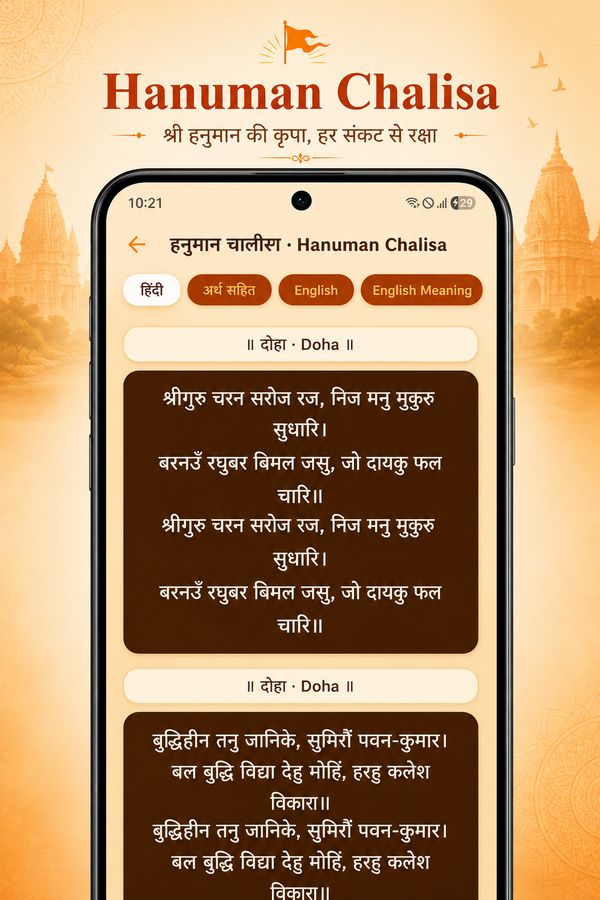
श्रीगुरु चरन सरोज रज, निज मनु मुकुरु सुधारि।
बरनउँ रघुबर बिमल जसु, जो दायकु फल चारि॥
Shri Guru charan saroj raj, nij manu mukuru sudhaari,
Baranau Raghuvar bimal jasu, jo daayaku phal chaari.
हिंदी अर्थ
सबसे पहले मैं अपने गुरु जी को प्रणाम करता हूँ, उनके चरणों की धूल लेकर अपना मन साफ करता हूँ। मन साफ करने के बाद अब मैं भगवान राम की कहानी और उनकी महिमा गाने जा रहा हूँ। ये कहानी सुनने से इंसान की चार सबसे बड़ी ज़रूरतें पूरी हो जाती हैं - धर्म यानी अच्छे कर्म, अर्थ यानी पैसा-दौलत, काम यानी इच्छाएं, और मोक्ष यानी आखिर में भगवान से मिलन। मतलब - पहले गुरु को नमन करो, मन शुद्ध करो, फिर भक्ति शुरू करो। तभी असली फल मिलता है।
English Meaning
Before I say anything else, I bow down to the dust of my guru's holy feet, and with that sacred dust I clean my mind. Only after purifying my mind in this way am I ready to describe the spotless, glorious fame of Lord Rama.Simply hearing this story of Rama's glory has the power to grant a person the four greatest goals of human life - dharma, meaning righteous conduct and good deeds; artha, meaning wealth and prosperity; kama, meaning the fulfilment of one's desires; and finally moksha, meaning ultimate liberation and union with God. In short, first bow to your guru, first purify your mind, and only then begin your devotion. That is the only way true, lasting fruit is received.
बुद्धिहीन तनु जानिके, सुमिरौं पवन-कुमार।
बल बुद्धि विद्या देहु मोहिं, हरहु कलेश विकार॥
Buddhiheen tanu jaanike, sumirau Pavan Kumar,
Bal buddhi vidya dehu mohi, harahu kalesh vikaar.
हिंदी अर्थ
मुझे पता है कि मेरा शरीर और बुद्धि बहुत कमज़ोर है, इसलिए मैं पवनपुत्र हनुमान जी को याद करता हूँ। हे हनुमान जी, मुझे ताकत दो, अच्छी बुद्धि दो, ज्ञान दो, और मेरे सारे दुख-तकलीफ और बुराइयाँ दूर कर दो। मतलब - अपनी कमज़ोरी मानकर हनुमान जी से मदद माँगी जा रही है।
English Meaning
I am fully aware that this body of mine and my intellect are both very weak; they do not have the strength. So instead, I turn directly to Hanuman ji, the son of the wind god, because he is regarded as the strongest, wisest, and most learned of all. O Hanuman ji, please give me physical strength, give me sound intelligence, and give me true knowledge, so that I may be able to complete this task. And along with that, please remove all the sorrows, afflictions, and flaws present in my mind and my life. This humble admission of one's own weakness, followed by turning to God for support, is really where true devotion begins.
जय हनुमान ज्ञान गुण सागर।
जय कपीश तिहुँ लोक उजागर॥
Jai Hanuman gyaan gun saagar,
Jai Kapis tihun lok ujaagar.
हिंदी अर्थ
हे हनुमान जी, आपकी जय हो! आप ज्ञान और अच्छे गुणों के समुद्र हो, यानी आपमें अच्छाई की कोई कमी नहीं। आप वानरों के राजा हो और आपकी कीर्ति तीनों लोकों में फैली हुई है - धरती, आकाश और पाताल, हर जगह लोग आपको मानते हैं।
English Meaning
O Hanuman ji, glory to you! You are an ocean of wisdom and virtue, meaning your good qualities are as vast and uncountable as the water in an ocean - there is simply no measuring them. He calls Hanuman ji "Kapis," the lord of the monkeys. And his fame is not confined to any one place - it shines brightly across all three worlds: the heavens above, the earth in the middle, and the netherworld below. Everywhere, in every realm, he is known and revered.
राम दूत अतुलित बलधामा।
अंजनि-पुत्र पवनसुत नामा॥
Ram doot atulit bal dhaama,
Anjani putra Pavan sut naama.
हिंदी अर्थ
आप भगवान राम के दूत हो और आपके पास इतनी ताकत है जिसकी कोई तुलना नहीं की जा सकती। आपकी माता का नाम अंजनी है इसलिए आपको अंजनिपुत्र कहा जाता है, और पवन देव के आशीर्वाद से जन्मे इसलिए आपको पवनसुत भी कहा जाता है।
English Meaning
First, it says that he is Lord Rama's most trusted messenger - every message, every task that Rama needed carried out, was entrusted to him. It then says that he is a storehouse of incomparable strength - power so immense that nothing in this world can truly be compared to it. Finally, two of his names are explained - "Anjani-putra," because his mother's name was Anjani, and "Pavansut," because the wind god Pavan played a special, blessed role in his birth. This is also why he is regarded as being as swift and powerful as the wind itself.
महाबीर बिक्रम बजरंगी।
कुमति निवार सुमति के संगी॥
Mahaveer vikram Bajrangi,
Kumati nivar sumati ke sangi.
हिंदी अर्थ
यहाँ हनुमान जी की वीरता और उनके स्वभाव, दोनों की बात हो रही है। आपको महावीर कहा गया है क्योंकि युद्ध के मैदान में आपसे बड़ा बहादुर योद्धा मिलना मुश्किल है, और बिक्रम यानी पराक्रम में भी आप सबसे आगे हो। बजरंगी शब्द का मतलब है कि आपका शरीर वज्र जितना मज़बूत और कठोर है, कोई हथियार उसे आसानी से चोट नहीं पहुँचा सकता। लेकिन सिर्फ ताकत ही नहीं, आपमें एक और खूबी है - आप कुमति यानी बुरी और नकारात्मक सोच को दूर भगाने वाले हो, और सुमति यानी अच्छी, सही सोच रखने वालों के साथी और सहायक हो। मतलब जो भी सच्चे दिल से आपकी भक्ति करता है, उसके मन से बुरे विचार अपने आप दूर होने लगते हैं और उसकी बुद्धि सही राह पर चलने लगती है।
English Meaning
This verse speaks both of Hanuman ji's valour and his gentler nature toward devotees. He is called "Mahabir," the great hero, because on the battlefield there is scarcely a warrior braver than him, and "Bikram" refers to his outstanding prowess and courage. The word "Bajrangi" describes how his very body is as hard and unbreakable as a thunderbolt (vajra) - no weapon can easily harm him. But alongside all this raw power, he has another beautiful quality - he drives away "kumati," meaning bad, negative, or corrupted thinking, and he stands as a companion and support to "sumati," meaning good, righteous thinking. In other words, whoever devotes themselves sincerely to him finds their own thoughts gradually purified and guided onto the right path.
कंचन बरन बिराज सुबेसा।
कानन कुंडल कुंचित केसा॥
Kanchan baran biraaj subesa,
Kaanan kundal kunchit kesa.
हिंदी अर्थ
अब तुलसीदास जी हनुमान जी के सुंदर, दिव्य रूप का वर्णन करने लगते हैं, ताकि भक्त के मन में उनकी एक साफ तस्वीर बन सके। कहा गया है कि आपके शरीर का रंग सोने जैसा चमकीला और तेजस्वी है, और आप बहुत सुंदर, आकर्षक वस्त्रों में सजे हुए विराजमान रहते हो। आपके दोनों कानों में सुंदर कुंडल पहने हुए हैं जो आपकी शोभा को और बढ़ाते हैं, और आपके बाल घुँघराले यानी कुंचित हैं, जो देखने में बहुत आकर्षक लगते हैं। ये पूरा वर्णन इसलिए किया गया है ताकि भक्त ध्यान करते समय हनुमान जी के इस सुंदर, बलवान और दिव्य स्वरूप की कल्पना कर सके और उसमें डूब जाए।
English Meaning
Here Tulsidas ji begins describing Hanuman ji's beautiful, divine form, so that the devotee can picture him clearly in their mind during worship or meditation. It says that his body glows with a golden hue, radiant and glowing, and that he is always adorned in fine, attractive garments. Beautiful earrings adorn both his ears, adding further to his splendour, and his hair is described as curly, which only adds to his handsome appearance. This detailed physical description exists purely so that the devotee, while chanting or meditating, can hold in their mind a vivid, loving image of Hanuman ji's radiant and powerful divine form.
हाथ बज्र औ ध्वजा बिराजै।
काँधे मूँज जनेऊ साजै॥
Haath bajra aur dhwaja biraajai,
Kaandhe moonj janeu saajai.
हिंदी अर्थ
यहाँ हनुमान जी के हाथों में मौजूद चीज़ों का वर्णन है, जो उनके दो अलग-अलग रूपों को दिखाता है। एक हाथ में आपने वज्र यानी गदा जैसा मज़बूत हथियार पकड़ा हुआ है, जो ये दिखाता है कि आप एक शक्तिशाली योद्धा हो, बुराई का नाश करने के लिए हमेशा तैयार। दूसरे हाथ में आपने ध्वजा यानी एक झंडा उठा रखा है, जो विजय और भगवान राम की सेवा का प्रतीक है। इसके साथ ही आपके कंधे पर मूँज नाम की घास से बना हुआ जनेऊ यानी यज्ञोपवीत भी सजा हुआ है। ये जनेऊ इस बात का प्रतीक है कि आप सिर्फ एक ताकतवर योद्धा ही नहीं, बल्कि एक सच्चे ब्रह्मचारी, तपस्वी और धार्मिक भी हो - यानी आपमें शक्ति और भक्ति दोनों का सुंदर संगम है।
English Meaning
This verse describes what Hanuman ji holds in his hands, symbolising two different aspects of who he is. In one hand he carries a "vajra," a mace-like weapon as hard as thunder, showing that he is a mighty warrior, always ready to strike down evil. In the other hand he carries a "dhwaja," a banner or flag, symbolising victory and his eternal service to Lord Rama. Along with these, a sacred thread (janeu) woven from "moonj" grass rests upon his shoulder. This sacred thread is a symbol that he is not merely a powerful fighter, but also a true, disciplined celibate ascetic (brahmachari) and deeply religious - meaning that in him, immense strength and pure devotion exist together in perfect harmony.
शंकर सुवन केसरीनंदन।
तेज प्रताप महा जग वंदन॥
Shankar suvan Kesari nandan,
Tej prataap maha jag vandan.
हिंदी अर्थ
इस पंक्ति में हनुमान जी के जन्म और उनकी महिमा के बारे में बताया गया है। कहा जाता है कि आप भगवान शिव के ही एक अंश या रूप हो, इसलिए आपको संकर सुवन यानी शिव जी का पुत्र भी कहा जाता है। साथ ही आपका पालन-पोषण करने वाले पिता केसरी जी थे, इसलिए आपको केसरीनंदन के नाम से भी जाना जाता है। आपका तेज यानी आपकी चमक और शक्ति, और आपका प्रताप यानी आपका प्रभाव इतना ज़्यादा है कि पूरी दुनिया उसे मानती है। यही वजह है कि पूरा संसार आपको वंदन करता है यानी आपको प्रणाम करता है और आपकी पूजा करता है।
English Meaning
This verse speaks of Hanuman ji's divine origin and his greatness. It is said that he is himself considered a form or manifestation of Lord Shiva, which is why he is called "Sankar Suvan," the son of Shiva. At the same time, his earthly father who raised him was Kesari, so he is equally called "Kesarinandan." His radiance ("tej") and his influence ("pratap") are so immense that the entire world acknowledges them. This is why the whole world bows down to him and worships him.
विद्यावान गुनी अति चातुर।
राम काज करिबे को आतुर॥
Vidyavaan guni ati chatur,
Ram kaaj karibe ko aatur.
हिंदी अर्थ
यहाँ हनुमान जी के गुणों और उनके स्वभाव की तारीफ की जा रही है। कहा गया है कि आप विद्यावान हो यानी आपके पास बहुत ज्ञान है, आप गुणी हो यानी आपमें बहुत सारे अच्छे गुण हैं, और आप अति चातुर हो यानी बहुत ही समझदार और होशियार हो, हर मुश्किल परिस्थिति को सुलझाने की कला आपको आती है। लेकिन इन सब गुणों से भी बड़ी बात ये है कि आप हमेशा राम जी का काम करने के लिए आतुर यानी बेचैन और उत्सुक रहते हो। यही आपकी सबसे बड़ी खासियत है कि ज्ञान के साथ-साथ आपमें सेवा-भाव भी उतना ही गहरा है।
English Meaning
This verse praises Hanuman ji's inner qualities and disposition. It says that he is deeply learned ("vidyavan"), full of virtues ("guni"), and extremely clever ("ati chatur") - he has the skill and wisdom to solve even the most difficult situations. But greater than all of these qualities is the fact that he is always restless and eager ("aatur") to carry out Lord Rama's work. This eagerness to serve, matched equally with his wisdom, is what truly defines him.
प्रभु चरित्र सुनिबे को रसिया।
राम लखन सीता मन बसिया॥
Prabhu charitra sunibe ko rasiya,
Ram Lakhan Sita man basiya.
हिंदी अर्थ
इस पंक्ति में हनुमान जी की भक्ति के स्वभाव को दिखाया गया है। कहा गया है कि आपको भगवान राम की लीलाएँ और कहानियाँ सुनना बहुत ही प्रिय है, आप रसिया हो यानी उन कथाओं को सुनते-सुनते पूरी तरह उसमें डूब जाते हो, मानो कोई प्यासा पानी पी रहा हो। और सिर्फ कहानियाँ सुनना ही नहीं, बल्कि भगवान राम, उनके भाई लक्ष्मण और माता सीता - ये तीनों हमेशा आपके मन में, आपके दिल में बसे रहते हैं। मतलब आपका पूरा जीवन, आपकी हर साँस इन्हीं तीनों की भक्ति और सेवा के इर्द-गिर्द घूमती है, आप कभी इनसे अलग नहीं हो सकते।
English Meaning
This verse shows the devotional nature of Hanuman ji. It says that he deeply loves hearing the stories and deeds of Lord Rama - he is "rasiya," meaning he becomes completely absorbed in these tales, drinking them in the way a thirsty person drinks water. And it is not just the stories that captivate him - Rama, his brother Lakshman, and Mother Sita are permanently seated within his heart and mind. This means his entire existence, every breath he takes, revolves around devotion and service to these three; he can never be separated from them.
सूक्ष्म रूप धरि सियहिं दिखावा।
बिकट रूप धरि लंक जरावा॥
Sookshma roop dhari Siyahi dikhava,
Bikat roop dhari Lanka jarava.
हिंदी अर्थ
यहाँ रामायण की एक मशहूर घटना का ज़िक्र है। जब हनुमान जी सीता माता की खोज में समुद्र पार करके लंका पहुँचे थे, तो वहाँ रावण के पहरे और राक्षसों से बचने के लिए उन्होंने बहुत ही छोटा, सूक्ष्म रूप धारण किया और चुपके से अशोक वाटिका में जाकर सीता माता को अपना असली परिचय दिया और भगवान राम की अंगूठी दिखाई। लेकिन इसके बाद जब लंका में राक्षसों ने उन्हें पकड़कर उनकी पूँछ में आग लगा दी, तो हनुमान जी ने अपना विशाल रूप, यानी बिकट रूप धारण किया और उसी जलती हुई पूँछ से पूरी लंका नगरी को जला डाला। इस पंक्ति से पता चलता है कि आप अपनी इच्छा के अनुसार कभी बहुत छोटा तो कभी बहुत बड़ा रूप ले सकते हो, जैसी ज़रूरत हो वैसा रूप बना लेते हो।
English Meaning
This refers to a famous episode from the Ramayana. When Hanuman ji crossed the ocean in search of Sita and reached Lanka, he took on a very small, subtle form ("sukshma roop") in order to avoid Ravana's guards and the demons patrolling the city, and quietly entered the Ashoka grove where he revealed his true identity to Sita and showed her Rama's ring as proof. Later, when the demons captured him and set his tail on fire, Hanuman ji took on a massive form ("bikat roop") and used that very burning tail to set the entire city of Lanka ablaze. This verse shows that he can, at will, take on either a tiny, unnoticeable form or an enormous one, whichever the situation demands.
भीम रूप धरि असुर संहारे।
रामचंद्र के काज सँवारे॥
Bheem roop dhari asur sanhaare,
Ramachandra ke kaaj sanvaare.
हिंदी अर्थ
यहाँ बताया गया है कि युद्ध के दौरान जब भी ज़रूरत पड़ी, हनुमान जी ने बहुत ही विशाल रूप धारण किया और अपनी शक्ति से बहुत सारे राक्षसों और असुरों का नाश किया। चाहे लंका में युद्ध हो या रावण की सेना के बड़े-बड़े योद्धाओं से मुकाबला, आपने अपनी वीरता से उन सबको परास्त किया। इस तरह आपने भगवान रामचंद्र जी के हर काम को, यानी सीता माता को वापस लाने और रावण का अंत करने के कार्य को, पूरी तरह सफल बनाने में अपनी अहम भूमिका निभाई। बिना आपकी मदद के राम जी के लिए ये सब काम इतना आसान नहीं होता।
English Meaning
This verse tells us that whenever it was necessary during the war, Hanuman ji assumed a massive form and used his power to destroy countless demons and asuras. Whether it was in open battle in Lanka or facing off against Ravana's mightiest warriors, his valour ensured their defeat. In this way, he made sure that every task of Lord Ramachandra - the mission to rescue Sita and put an end to Ravana - was carried through to complete success. Without his help, this entire mission would have been far more difficult for Rama to accomplish.
लाय सजीवन लखन जियाये।
श्रीरघुबीर हरषि उर लाये॥
Laay sanjeevan Lakhan jiyaaye,
Shri Raghuveer harashi ur laaye.
हिंदी अर्थ
यह रामायण की सबसे भावुक और मशहूर घटनाओं में से एक है। युद्ध के दौरान जब मेघनाद के शक्ति-बाण से लक्ष्मण जी बुरी तरह घायल होकर मूर्छित यानी बेहोश हो गए थे, और वैद्य ने कहा कि उन्हें बचाने के लिए हिमालय पर्वत से संजीवनी बूटी लानी होगी, तभी हनुमान जी तुरंत उड़कर हिमालय गए। पूरी बूटी न पहचान पाने पर वो पूरा पर्वत ही उठाकर ले आए, और उस संजीवनी बूटी से लक्ष्मण जी की जान बच गई। इतने कठिन समय में आपने जो साहस और तेज़ी दिखाई, उसे देखकर भगवान श्रीराम बहुत खुश हुए और भावुक होकर उन्होंने आपको अपने गले से लगा लिया - ये पल हनुमान जी की भक्ति और राम जी के स्नेह, दोनों को दिखाता है।
English Meaning
This describes one of the most moving and famous episodes of the entire Ramayana. During the war, when Lakshman was severely wounded and fell unconscious after being struck by Meghnad's powerful weapon, the physicians declared that only the Sanjeevani herb from the Himalayas could save his life. Hanuman ji immediately flew to the Himalayas, and unable to identify the exact herb, he simply lifted the entire mountain and carried it back. That herb saved Lakshman's life. Seeing the courage and speed Hanuman ji showed in this moment of crisis, Lord Rama was overwhelmed with joy and, deeply moved, embraced him tightly. This moment beautifully captures both Hanuman ji's devotion and Rama's deep affection for him.
रघुपति कीन्ही बहुत बड़ाई।
तुम मम प्रिय भरतहि सम भाई॥
Raghupati keenhi bahut badaai,
Tum mam priya Bharat hi sam bhai.
हिंदी अर्थ
लक्ष्मण जी की जान बचाने के बाद भगवान राम इतने भावुक और प्रसन्न हुए कि उन्होंने हनुमान जी की खुले दिल से बहुत तारीफ की। उन्होंने कहा कि तुम मुझे उतने ही प्रिय हो जितना मेरा सगा भाई भरत मुझे प्रिय है। ये बहुत बड़ी बात थी, क्योंकि भरत जी को राम जी अपने प्राणों से भी बढ़कर मानते थे। इस तरह भगवान राम ने हनुमान जी को अपने दिल के सबसे करीबी स्थान पर बिठा दिया। इससे ये सीख मिलती है कि सच्ची भक्ति और सेवा से इंसान भगवान के दिल में जगह बना सकता है ।
English Meaning
After Lakshman's life was saved, Lord Rama was so moved and pleased that he openly praised Hanuman ji from the heart. He said that Hanuman was as dear to him as his own brother Bharat. This was an extraordinarily high honour, because Bharat held a place in Rama's heart that was considered second to none. In this way, Lord Rama gave him one of the closest places in his heart. The lesson here is that true devotion and selfless service can earn someone a place in God's heart.
सहस बदन तुम्हारो जस गावैं।
अस कहि श्रीपति कंठ लगावैं॥
Sahas badan tumharo jas gaavein,
As kahi Shripati kanth lagaavein.
हिंदी अर्थ
भगवान राम ने आगे कहा कि हज़ारों मुँह वाले शेषनाग जी, जो भगवान विष्णु के शय्या यानी बिस्तर के रूप में काम करते हैं और जिन्हें अनंत भी कहा जाता है, वो भी लगातार तुम्हारी महिमा और यश का गुणगान करते रहते हैं। इतना बड़ा है तुम्हारा जस यानी कीर्ति, कि हज़ारों मुँह से भी उसका पूरा वर्णन नहीं हो पाता। ऐसा कहकर भगवान राम, जिन्हें यहाँ श्रीपति कहा गया है, उन्होंने एक बार फिर हनुमान जी को अपने गले से लगाया।
English Meaning
Lord Rama continued, saying that even Sheshnag, the thousand-headed serpent god who serves as Lord Vishnu's resting couch and is also known as "Anant" (the endless one), continuously sings praises of Hanuman ji's glory. So vast is his fame ("jas") that even a thousand mouths together cannot fully describe it. Having said this, Lord Rama, referred to here as "Shripati," embraced Hanuman ji once again.
सनकादिक ब्रह्मादि मुनीसा।
नारद सारद सहित अहीसा॥
Sanakaadik Brahmaadi muneesa,
Narad Saarad sahit Aheesa.
हिंदी अर्थ
अब तुलसीदास जी बताते हैं कि सिर्फ भगवान राम ही नहीं, बल्कि सृष्टि के बड़े-बड़े देवता और ऋषि-मुनि भी हनुमान जी की महिमा गाते हैं। इसमें सनक, सनंदन जैसे चार कुमार ऋषि शामिल हैं, ब्रह्मा जी और दूसरे बड़े मुनिजन शामिल हैं, संगीत और वाणी के देवता नारद जी शामिल हैं, विद्या और ज्ञान की देवी माता सरस्वती शामिल हैं, और अहीसा यानी शेषनाग जी भी शामिल हैं। इतने महान और शक्तिशाली देवी-देवता जब खुद हनुमान जी की तारीफ करते हैं, तो इससे पता चलता है कि हनुमान जी का दर्जा कितना ऊँचा है - सिर्फ इंसानों में ही नहीं, बल्कि देवताओं की दुनिया में भी उनका सम्मान बहुत ज़्यादा है।
English Meaning
Tulsidas ji now explains that it is not only Lord Rama who praises Hanuman ji - even the greatest gods and sages of creation sing his glory. This includes Sanak and the other Kumara sages, Lord Brahma and other great sages, Narada, the divine sage of music and speech, Goddess Saraswati, the goddess of knowledge, and Sheshnag, the serpent god. When such powerful and revered divine beings themselves praise Hanuman ji, it shows just how elevated his stature truly is - respected not only among humans, but honoured deeply even within the world of the gods.
जम कुबेर दिगपाल जहाँ ते।
कबि कोबिद कहि सके कहाँ ते॥
Yam Kuber digpaal jahan te,
Kabi kobid kahi sake kahan te.
हिंदी अर्थ
यहाँ कहा गया है कि यमराज, जो मृत्यु के देवता हैं, कुबेर जी, जो धन के देवता हैं, और दसों दिशाओं की रक्षा करने वाले दिगपाल देवता - ये सब भी हनुमान जी की महिमा का पूरा वर्णन नहीं कर पाते, तो फिर आम कवि और विद्वान लोग, जो कबि कोबिद कहलाते हैं, वो भला अपनी सीमित बुद्धि और शब्दों से आपके गुणों को पूरी तरह कैसे बयान कर सकते हैं? मतलब ये है कि हनुमान जी की महिमा इतनी विशाल और असीम है कि उसे शब्दों की कोई सीमा पूरी तरह से बाँध ही नहीं सकती, चाहे कितने भी बड़े विद्वान क्यों न कोशिश कर लें।
English Meaning
It says that even Yamraj, the god of death, Kuber, the god of wealth, and the guardian deities of the ten directions cannot fully describe Hanuman ji's glory - so how could ordinary poets and scholars ("kabi kobid"), with their limited words and understanding, ever hope to capture his qualities completely? The meaning here is that Hanuman ji's glory is so vast and boundless that no words, however skilfully arranged, could ever contain it fully - no matter how great the scholar attempting it.
तुम उपकार सुग्रीवहिं कीन्हा।
राम मिलाय राजपद दीन्हा॥
Tum upkaar Sugreevahin keenha,
Ram milaye raajpad deenha.
हिंदी अर्थ
यहाँ रामायण की एक और महत्वपूर्ण घटना का ज़िक्र है। जब सुग्रीव अपने भाई बालि के डर से जंगल में छिपे हुए थे और अपना राजपाट खो चुके थे, तब हनुमान जी ने ही उनकी मुलाकात भगवान राम से करवाई। इसी मुलाकात की वजह से आगे चलकर भगवान राम ने बालि का वध किया और सुग्रीव को दोबारा किष्किंधा का राजा बना दिया। इस तरह हनुमान जी ने सुग्रीव पर बहुत बड़ा उपकार किया, उन्हें उनका खोया हुआ राज-पाट वापस दिलाने में अहम भूमिका निभाई। यही दोस्ती और मदद आगे चलकर सीता माता की खोज में भी बहुत काम आई, क्योंकि सुग्रीव ने अपनी पूरी वानर सेना राम जी की मदद के लिए भेजी।
English Meaning
This refers to another important episode of the Ramayana. When Sugriva was hiding in the forest, having lost his kingdom out of fear of his brother Bali, it was Hanuman ji who arranged his meeting with Lord Rama. Because of this meeting, Rama eventually killed Bali and restored the throne of Kishkindha to Sugriva. In this way, Hanuman ji did Sugriva an enormous favour, playing the key role in helping him regain his lost kingdom. This friendship later proved crucial in the search for Sita as well, since Sugriva sent his entire monkey army to assist Rama's cause.
तुम्हारो मंत्र विभीषन माना।
लंकेश्वर भए सब जग जाना॥
Tumharo mantra Vibheeshan maana,
Lankeshwar bhaye sab jag jaana.
हिंदी अर्थ
यहाँ विभीषण जी की कहानी का ज़िक्र है। रावण का छोटा भाई विभीषण एक धर्मात्मा और सच्चाई का साथ देने वाला व्यक्ति था, वो रावण की गलतियों और अधर्म से बहुत दुखी था। कहा जाता है कि हनुमान जी की सलाह और समझाने पर ही विभीषण ने अपने भाई रावण का साथ छोड़कर भगवान राम की शरण ली। इस फैसले का नतीजा ये हुआ कि जब रावण का अंत हुआ, तो भगवान राम ने विभीषण को ही लंका का नया राजा यानी लंकेश्वर बना दिया। ये बात पूरी दुनिया जानती है और आज भी विभीषण को धर्म और सच्चाई के रास्ते पर चलने वाले व्यक्ति के उदाहरण के रूप में याद किया जाता है, और इसका श्रेय काफी हद तक हनुमान जी की सलाह को जाता है।
English Meaning
This tells the story of Vibhishan. Ravana's younger brother Vibhishan was a righteous, truth-loving man who was deeply troubled by his brother's injustice and wrongdoing. It is said that it was on Hanuman ji's advice and counsel that Vibhishan decided to abandon his brother Ravana and take refuge with Lord Rama. As a result of this decision, when Ravana was finally defeated, Lord Rama made Vibhishan the new king of Lanka, "Lankeshwar." This is a fact known throughout the world, and even today Vibhishan is remembered as an example of choosing righteousness and truth over blind loyalty - a decision that is largely credited to Hanuman ji's guidance.
जुग सहस्त्र जोजन पर भानू।
लील्यो ताहि मधुर फल जानू॥
Yug sahastra yojan par bhaanu,
Leelyo taahi madhur phal jaanu.
हिंदी अर्थ
यह घटना हनुमान जी के बचपन की है। कहा जाता है कि जब हनुमान जी बहुत छोटे थे, तब एक दिन उन्होंने आकाश में चमकते हुए सूरज को देखा, जो असल में धरती से हज़ारों योजन यानी बहुत ही ज़्यादा दूरी पर स्थित है। बालक हनुमान ने भूख के कारण या खेल-खेल में उसे कोई मीठा, लाल रंग का फल समझ लिया और उड़कर उसे मुँह में डालने के लिए आकाश की तरफ छलांग लगा दी। इस घटना से पता चलता है कि जन्म से ही हनुमान जी में असाधारण, अलौकिक शक्ति थी। ये उनकी दिव्य शक्तियों का पहला संकेत माना जाता है।
English Meaning
This event is from Hanuman ji's childhood. It is said that when he was still very young, he once looked up and saw the glowing sun in the sky, which is actually located thousands of "yojanas" (a huge unit of distance) away from the earth. Out of hunger or childlike playfulness, baby Hanuman mistook it for some sweet, red fruit, and leapt into the sky to try and grab it in his mouth. This event shows that even as a child, Hanuman ji possessed extraordinary power. This is considered the very first sign of his divine abilities.
प्रभु मुद्रिका मेलि मुख माहीं।
जलधि लाँघि गये अचरज नाहीं॥
Prabhu mudrika meli mukh maahi,
Jaladhi langhi gaye acharaj naahi.
हिंदी अर्थ
जब सीता माता की खोज के लिए हनुमान जी को लंका जाना था, तो भगवान राम ने अपनी पहचान के तौर पर अपनी अँगूठी हनुमान जी को दी, ताकि सीता माता को यकीन हो जाए कि हनुमान जी सच में राम जी के भेजे हुए दूत हैं। हनुमान जी ने उस अँगूठी को अपने मुँह में सुरक्षित रखा और फिर विशाल समुद्र को एक ही छलांग में लांघ गए। तुलसीदास जी कहते हैं कि इसमें कोई हैरानी की बात नहीं है, क्योंकि जिनके पास इतनी असीम शक्ति है, उनके लिए समुद्र पार करना कोई बड़ी बात नहीं। यहाँ भक्त को याद दिलाया जा रहा है कि हनुमान जी के लिए कोई भी काम असंभव नहीं है।
English Meaning
When Hanuman ji had to travel to Lanka in search of Sita, Lord Rama gave him his own ring as a token of identification, so that Sita would be certain he was truly sent by Rama. Hanuman ji safely carried this ring in his mouth and then leapt across the vast ocean in a single bound. Tulsidas ji says that there is nothing surprising about this - for someone possessing such boundless power, crossing an ocean is no great matter at all. The devotee is reminded here that for Hanuman ji, no task is ever truly impossible.
दुर्गम काज जगत के जेते।
सुगम अनुग्रह तुम्हरे तेते॥
Durgam kaaj jagat ke jete,
Sugam anugrah tumhare tete.
हिंदी अर्थ
इस पंक्ति में हनुमान जी की कृपा की महिमा बताई गई है। कहा गया है कि इस दुनिया में जितने भी दुर्गम यानी बहुत कठिन, लगभग असंभव लगने वाले काम हैं, वो सब आपकी कृपा और अनुग्रह मिलने से बहुत आसान बन जाते हैं। जैसे समुद्र पार करना, लंका जलाना, संजीवनी बूटी लाना - ये सब काम आम इंसान के लिए असंभव थे, लेकिन आपके लिए सुगम यानी सरल हो गए। इसी तरह भक्तों का मानना है कि अगर सच्चे मन से हनुमान जी की भक्ति की जाए और उनकी कृपा मिल जाए, तो जीवन की कोई भी बड़ी से बड़ी मुश्किल आसानी से हल हो सकती है।
English Meaning
This verse speaks of the power of Hanuman ji's grace. It says that whatever difficult, seemingly impossible tasks ("durgam kaj") exist in this world, they all become easy and simple through his blessing and grace. Just as crossing the ocean, burning down Lanka, and bringing back the Sanjeevani herb were impossible tasks for an ordinary person but became effortless for him, devotees believe that if one sincerely worships Hanuman ji and receives his grace, even the greatest difficulties in life can be resolved with ease.
राम दुआरे तुम रखवारे।
होत न आज्ञा बिनु पैसारे॥
Ram dwaare tum rakhvaare,
Hot na aagya binu paisaare.
हिंदी अर्थ
यहाँ हनुमान जी की एक और भूमिका बताई गई है - वो भगवान राम के द्वार यानी दरवाज़े के रखवाले, यानी पहरेदार हैं। इसका मतलब है कि भगवान राम के दरबार तक पहुँचने के लिए, उनसे मिलने के लिए, पहले हनुमान जी की इजाज़त लेनी ज़रूरी है, बिना उनकी आज्ञा के कोई भी अंदर प्रवेश नहीं कर सकता। इसका गहरा अर्थ ये भी निकाला जाता है कि अगर भगवान राम की कृपा और उनका आशीर्वाद पाना है, तो पहले हनुमान जी को प्रसन्न करना होगा, उनकी भक्ति करनी होगी - वो ही भगवान तक पहुँचने का रास्ता आसान बनाते हैं।
English Meaning
Here another one of Hanuman ji's roles is described - he stands as the gatekeeper ("rakhware") at the door of Lord Rama. This means that to reach Rama's court, to gain audience with him, one must first receive Hanuman ji's permission - no one can enter without his consent. A deeper meaning often drawn from this is that in order to receive Lord Rama's grace and blessing, one must first please Hanuman ji and devote oneself to him - he is the one who makes the path to God accessible.
सब सुख लहै तुम्हारी सरना।
तुम रच्छक काहू को डरना॥
Sab sukh lahai tumhaari sarna,
Tum rakshak kaahu ko darna.
हिंदी अर्थ
इस पंक्ति में हनुमान जी की शरण में आने के फायदे बताए गए हैं। कहा गया है कि जो भी व्यक्ति सच्चे मन से आपकी शरण में आता है, यानी आप पर पूरा भरोसा करके आपकी भक्ति करता है, उसे जीवन के सारे सुख अपने आप मिलने लगते हैं। और जब खुद हनुमान जी जैसा शक्तिशाली और वीर रक्षक किसी की रक्षा करने के लिए खड़ा हो, तो फिर उस व्यक्ति को दुनिया की किसी भी चीज़ से, किसी भी मुसीबत से डरने की ज़रूरत नहीं रह जाती। यही वजह है कि लोग मुश्किल समय में सबसे पहले हनुमान जी को याद करते हैं, क्योंकि उन्हें भरोसा है कि वो हर हाल में उनकी रक्षा करेंगे।
English Meaning
This verse describes the benefits of taking refuge in Hanuman ji. It says that whoever sincerely takes shelter under him, meaning places their complete trust in him and devotes themselves to him, automatically experiences every joy in life. And when a protector as powerful and heroic as Hanuman ji is standing guard over someone, that person need not fear anything else in the world at all. This is exactly why people, in times of trouble, turn to Hanuman ji first - because they trust that he will protect them no matter what.
आपन तेज सम्हारो आपै।
तीनों लोक हाँक तें काँपै॥
Aapan tej samhaaro aapai,
Teeno lok haank te kaampai.
हिंदी अर्थ
यहाँ हनुमान जी की असीम शक्ति और तेज का वर्णन है। कहा गया है कि आपका तेज इतना विशाल और प्रचंड है कि उसे संभालना सिर्फ आपके ही बस की बात है, कोई और उसे नहीं संभाल सकता। और जब आप युद्ध में गरजते हो, हुँकार भरते हो, तो उस आवाज़ से तीनों लोक - यानी स्वर्ग लोक, पृथ्वी लोक और पाताल लोक - काँप उठते हैं। ये बात याद दिलाती है कि हनुमान जी सिर्फ शांत और भक्ति भाव वाले नहीं, बल्कि ज़रूरत पड़ने पर इतने प्रचंड रूप में भी आ सकते हैं कि पूरी सृष्टि उनसे डर जाए। लेकिन ये शक्ति हमेशा धर्म और सच्चाई की रक्षा के लिए इस्तेमाल होती है।
English Meaning
This verse describes Hanuman ji's boundless power and radiance. It says that his energy ("tej") is so vast and fierce that only he himself is capable of containing it - no one else could ever hold such power. And when he roars in battle, his very war-cry causes all three worlds - heaven, earth, and the netherworld - to tremble. This is a reminder that Hanuman ji is not always calm and gentle in devotion; when the situation demands it, he can also manifest a form so overwhelming that all of creation shakes before it. Yet this power is always used solely in defence of righteousness and truth.
भूत पिसाच निकट नहिं आवै।
महाबीर जब नाम सुनावै॥
Bhoot pisaach nikat nahi aavai,
Mahaveer jab naam sunaavai.
हिंदी अर्थ
इस पंक्ति में बताया गया है कि हनुमान जी का नाम कितना शक्तिशाली है। कहा गया है कि जब भी कोई व्यक्ति सच्चे मन से आपका नाम "महावीर" पुकारता है या आपको याद करता है, तो भूत, पिसाच यानी बुरी आत्माएँ और नकारात्मक शक्तियाँ उसके पास भी नहीं आ पातीं, वो डरकर दूर भाग जाती हैं। सिर्फ नाम लेने भर से ही इतनी सुरक्षा मिल जाती है कि किसी और सुरक्षा-कवच की ज़रूरत नहीं रह जाती।
English Meaning
This verse explains just how powerful Hanuman ji's name is. It says that whenever someone sincerely calls out his name "Mahabir" or remembers him, ghosts, evil spirits, and negative forces cannot come anywhere near, and they flee in fear. Simply invoking his name is enough to provide protection so strong that no other safeguard is even needed.
नासै रोग हरै सब पीरा।
जपत निरंतर हनुमत बीरा॥
Naasai rog harai sab peera,
Japat nirantar Hanumat beera.
हिंदी अर्थ
यहाँ हनुमान जी की भक्ति के स्वास्थ्य से जुड़े फायदे बताए गए हैं। कहा गया है कि जो व्यक्ति लगातार, बिना रुके, श्रद्धा के साथ हनुमान जी का नाम जपता रहता है, उसके शरीर की बीमारियाँ नष्ट हो जाती हैं और उसके जीवन की सारी पीड़ाएँ, चाहे वो शारीरिक हों या मानसिक, दूर हो जाती हैं। ये इसलिए भी कहा गया है क्योंकि माना जाता है कि नियमित भक्ति और सकारात्मक सोच से इंसान का मन शांत रहता है, और मन शांत रहने से शरीर भी स्वस्थ रहने लगता है।
English Meaning
This verse describes the health-related benefits of devotion to Hanuman ji. It says that a person who continuously and faithfully chants the name of the mighty warrior Hanuman finds their diseases destroyed and every kind of pain in their life, whether physical or mental, removed. This is also said because regular devotion and positive focus are believed to bring peace to the mind, and a peaceful mind naturally leads to a healthier body.
संकट से हनुमान छुड़ावै।
मन क्रम बचन ध्यान जो लावै॥
Sankat se Hanuman chhudaavai,
Man kram vachan dhyaan jo laavai.
हिंदी अर्थ
इस पंक्ति में एक ज़रूरी शर्त के साथ हनुमान जी की कृपा का ज़िक्र है। कहा गया है कि जो कोई व्यक्ति अपने मन से, अपने कर्मों यानी काम से, और अपने वचन यानी बोले गए शब्दों से - यानी पूरी तरह सच्चे दिल और शुद्ध भाव से हनुमान जी का ध्यान करता है, तभी हनुमान जी उसे हर संकट और मुसीबत से बाहर निकालते हैं। यहाँ ज़ोर इस बात पर दिया गया है कि सिर्फ ज़बानी भक्ति काफी नहीं, बल्कि मन, कर्म और वचन तीनों में एकरूपता होनी चाहिए, तभी असली फल मिलता है।
English Meaning
This verse comes with an important condition attached to Hanuman ji's grace. It says that only when a person meditates upon Hanuman ji with their mind, their actions, and their words - meaning with complete sincerity and purity of heart across all three - does Hanuman ji rescue that person from every difficulty and crisis. The emphasis here is that mere verbal devotion is not enough; there must be true alignment between one's thoughts, deeds, and words for the real fruit of devotion to be received.
सब पर राम तपस्वी राजा।
तिन के काज सकल तुम साजा॥
Sab par Ram tapasvi raja,
Tin ke kaaj sakal tum saaja.
हिंदी अर्थ
यहाँ भगवान राम और हनुमान जी के रिश्ते को फिर से याद दिलाया गया है। कहा गया है कि भगवान राम सबसे ऊपर हैं, वो एक तपस्वी राजा हैं - यानी राजा होते हुए भी उन्होंने वनवास में तपस्वी जैसा सादा और संयमी जीवन जिया। और उन्हीं भगवान राम के सारे काम, चाहे वो सीता माता को खोजना हो, सेना इकट्ठा करना हो, या रावण से युद्ध करना हो - ये सब काम आपने ही पूरे किए, आपने ही उन्हें साजा यानी संवारा और सफल बनाया।
English Meaning
This verse reaffirms the relationship between Lord Rama and Hanuman ji. It says that Lord Rama stands above all - he is a "tapasvi raja," an ascetic king, meaning that even though he was a king by birth, he lived a simple, disciplined life like a sage during his years of exile. And it was Hanuman ji who carried out and completed all of this king's tasks - whether searching for Sita, gathering an army, or fighting Ravana - he was the one who arranged and accomplished them all.
और मनोरथ जो कोई लावै।
सोइ अमित जीवन फल पावै॥
Aur manorath jo koi laavai,
Soi amit jeevan phal paavai.
हिंदी अर्थ
इस पंक्ति में हनुमान जी की भक्ति से मिलने वाले फल की बात हो रही है। कहा गया है कि जो कोई भी व्यक्ति अपनी कोई इच्छा, कोई मनोरथ लेकर सच्चे दिल से हनुमान जी के पास आता है, उसे उस इच्छा का अमित यानी असीमित, बहुत बड़ा फल मिलता है। मतलब हनुमान जी सिर्फ उतना ही नहीं देते जितना माँगा गया हो, बल्कि उससे कहीं ज़्यादा और बेहतर फल देते हैं, क्योंकि वो बहुत दयालु और उदार माने जाते हैं। यही वजह है कि भक्त अपनी हर छोटी-बड़ी इच्छा लेकर बेझिझक हनुमान जी के सामने जाते हैं।
English Meaning
This verse speaks of the fruit received through devotion to Hanuman ji. It says that whoever comes to him with any wish or desire ("manorath"), with a sincere heart, receives boundless ("amit") fruit in return - far greater than what was even asked for. This means Hanuman ji does not merely grant exactly what is requested, but gives generously, even more than expected, because he is known for his kindness and generosity. This is why devotees approach him freely and without hesitation, whatever their wish, big or small.
चारों जुग परताप तुम्हारा।
है परसिद्ध जगत उजियारा॥
Chaaron yug prataap tumhaara,
Hai prasiddh jagat ujiyaara.
हिंदी अर्थ
यहाँ हनुमान जी की महिमा को समय की सीमा से परे बताया गया है। कहा गया है कि चारों युगों में - सतयुग, त्रेतायुग, द्वापरयुग और आज के कलियुग में - हर युग में आपका परताप यानी आपका प्रभाव और तेज बना रहा है, कभी कम नहीं हुआ। आपकी महिमा इतनी प्रसिद्ध है कि पूरी दुनिया में, जगत के हर कोने में आपका नाम रोशनी की तरह फैला हुआ है। इसीलिए हनुमान जी को चिरंजीवी यानी हमेशा जीवित रहने वाला और हर युग में मौजूद रहने वाला माना जाता है, वो कभी इस दुनिया से गए ही नहीं, हमेशा भक्तों की मदद के लिए मौजूद रहते हैं।
English Meaning
This verse places Hanuman ji's glory beyond the boundaries of time itself. It says that across all four ages - Satya Yuga, Treta Yuga, Dwapar Yuga, and today's Kali Yuga - his influence ("pratap") and radiance have remained undiminished, never fading. His fame ("parsiddha") has spread like light across every corner of the world. This is exactly why Hanuman ji is regarded as "chiranjeevi," meaning immortal, someone who continues to exist and remain present in every age, never truly leaving this world, always available to help his devotees.
साधु संत के तुम रखवारे।
असुर निकंदन राम दुलारे॥
Sadhu sant ke tum rakhvaare,
Asur nikandan Ram dulaare.
हिंदी अर्थ
इस पंक्ति में हनुमान जी की तीन बड़ी भूमिकाएँ बताई गई हैं। पहली - आप साधु-संतों और अच्छे, धार्मिक लोगों के रखवाले हो, यानी जो लोग सच्चाई और धर्म के रास्ते पर चलते हैं, उनकी रक्षा करना आपका काम है। दूसरी - आप असुर निकंदन हो, यानी राक्षसों और बुरी शक्तियों का नाश करने वाले हो, जो भी अधर्म फैलाने की कोशिश करता है उसे आप खत्म कर देते हो। और तीसरी - आप राम दुलारे हो, यानी भगवान राम के सबसे प्यारे और लाड़ले भक्त हो। इस तरह आप अच्छाई की रक्षा और बुराई के नाश, दोनों में सबसे आगे रहते हो, और इसी वजह से भगवान राम को सबसे ज़्यादा प्रिय भी हो।
English Meaning
This verse describes three major roles of Hanuman ji. First, he is the protector ("rakhware") of saints and holy, righteous people, meaning it is his duty to safeguard those who walk the path of truth and dharma. Second, he is "asur nikandan," the destroyer of demons and evil forces, ensuring that anyone attempting to spread unrighteousness is eliminated. Third, he is "Ram dulare," the most beloved and cherished devotee of Lord Rama. In this way, he stands at the forefront of both protecting goodness and destroying evil - and it is precisely because of this that he is held so dear by Lord Rama.
अष्टसिद्धि नौ निधि के दाता।
अस बर दीन जानकी माता॥
Ashta siddhi nau nidhi ke daata,
As bar deen Janaki mata.
हिंदी अर्थ
यहाँ बताया गया है कि हनुमान जी के पास कितनी बड़ी शक्तियाँ देने का अधिकार है। कहा गया है कि आप अष्ट सिद्धि यानी आठ अलग-अलग तरह की दिव्य शक्तियाँ (जैसे बहुत छोटा या बहुत बड़ा रूप बना लेना, बहुत हल्का या बहुत भारी हो जाना, इत्यादि) और नौ निधि यानी नौ तरह के खज़ाने या धन-संपत्ति देने वाले हो। ये बहुत बड़ा वरदान है और ये वरदान आपको खुद माता सीता, जिन्हें जानकी भी कहा जाता है, ने दिया था। मतलब आपके पास इतनी शक्ति है कि आप चाहें तो अपने सच्चे भक्तों को असीमित शक्तियाँ और धन-दौलत दोनों दे सकते हो।
English Meaning
This verse describes just how great a power Hanuman ji holds - the power to grant blessings to others. It says that he is the giver ("data") of the eight siddhis (mystical, supernatural abilities such as becoming extremely small or large, weightless or heavy, and so on) and the nine nidhis (nine types of divine treasures or forms of wealth). This tremendous boon was granted to him directly by Mother Sita herself, referred to here as "Janki." This means he has the power to bestow both unlimited spiritual abilities and material wealth upon his true devotees, should he choose to.
राम रसायन तुम्हरे पासा।
सदा रहो रघुपति के दासा॥
Ram rasaayan tumhare paasa,
Sada raho Raghupati ke daasa.
हिंदी अर्थ
इस पंक्ति में हनुमान जी की भक्ति की गहराई बताई गई है। "राम रसायन" का मतलब है भगवान राम की भक्ति रूपी अमृत, वो चीज़ जो हर दुख को मिटाकर अमरता और शांति देती है। कहा गया है कि ये अनमोल रसायन हमेशा आपके पास मौजूद रहता है, यानी आप हमेशा राम-भक्ति में डूबे रहते हो। और आप हमेशा, बिना रुके, भगवान राम, जिन्हें यहाँ रघुपति कहा गया है, उनके दास बनकर रहते हो। यही आपकी सबसे बड़ी पहचान और सबसे बड़ा गर्व है कि आप राम जी के सबसे समर्पित सेवक हो, कभी इस भाव से अलग नहीं होते।
English Meaning
This verse reveals the depth of Hanuman ji's devotion. "Ram Rasayan" refers to the nectar-like devotion to Lord Rama - something that removes all sorrow and grants a state of peace and near-immortality. It says that this priceless devotion is always present with him, meaning he remains eternally absorbed in devotion to Rama. And he remains, always and forever, the humble servant ("dasa") of Lord Rama, referred to here as "Raghupati." This is his greatest identity and his greatest source of pride - being the most devoted servant of Lord Rama, never once wavering from this role.
तुम्हरे भजन राम को पावै।
जनम जनम के दुख बिसरावै॥
Tumhare bhajan Ram ko paavai,
Janam janam ke dukh bisraavai.
हिंदी अर्थ
यहाँ बताया गया है कि हनुमान जी की भक्ति करने से क्या फल मिलता है। कहा गया है कि जो कोई व्यक्ति सच्चे मन से आपका भजन यानी आपकी भक्ति और पूजा करता है, उसे आखिरकार भगवान राम की प्राप्ति होती है, यानी वो भगवान के करीब पहुँच जाता है। और सिर्फ इतना ही नहीं, ऐसे भक्त के कई-कई जन्मों से चले आ रहे पुराने दुख-दर्द भी भुला दिए जाते हैं, मिट जाते हैं। मतलब हनुमान जी की भक्ति सिर्फ इस जन्म के दुख नहीं, बल्कि पिछले कई जन्मों के कर्मों से जुड़े दुखों को भी खत्म करने की ताकत रखती है।
English Meaning
This verse describes the fruit gained through devotion to Hanuman ji. It says that whoever sincerely performs devotional worship ("bhajan") to him ultimately attains Lord Rama himself, meaning they draw closer to God. And not only that, such a devotee's sorrows accumulated across many lifetimes ("janam janam") are also erased and forgotten. This means devotion to Hanuman ji has the power not just to remove the pains of this present life, but also those tied to karma carried over from previous births.
अंत काल रघुबर पुर जाई।
जहाँ जन्म हरि-भक्त कहाई॥
Ant kaal Raghubar pur jaai,
Jahan janm Hari bhakt kahaai.
हिंदी अर्थ
इस पंक्ति में बताया गया है कि सच्चे भक्त का अंत कैसा होता है। कहा गया है कि जो व्यक्ति जीवनभर सच्चे मन से हनुमान जी और भगवान राम की भक्ति करता है, उसकी मृत्यु के बाद, यानी अंतकाल में, वो सीधे रघुबर यानी भगवान राम के धाम में पहुँचता है। और अगर उसे दोबारा इस धरती पर जन्म लेना भी पड़े, तो भी वो हमेशा हरिभक्त यानी भगवान का भक्त कहलाता है, उसकी भक्ति अगले जन्म में भी उसके साथ बनी रहती है। इससे भक्तों को ये भरोसा मिलता है कि उनकी भक्ति कभी बेकार नहीं जाती, चाहे इस जन्म में हो या अगले जन्म में।
English Meaning
This verse describes what happens to a true devotee at the end of life. It says that a person who devotes themselves sincerely to Hanuman ji and Lord Rama throughout their life goes, at the time of death ("antkal"), directly to the abode of Lord Rama. And even if such a person must be reborn on this earth again, they will always be known as a devotee of Hari (God) - their devotion carries forward into their next life as well. This gives devotees the deep assurance that their devotion is never wasted, whether in this life or the next.
और देवता चित्त न धरई।
हनुमत सेइ सर्ब सुख करई॥
Aur devta chitt na dharai,
Hanumat sei sarb sukh karai.
हिंदी अर्थ
यहाँ हनुमान जी की भक्ति की पूर्णता के बारे में बताया गया है। कहा गया है कि अगर कोई व्यक्ति सिर्फ और सिर्फ हनुमान जी की सेवा और भक्ति में अपना मन लगाता है, तो उसे किसी और देवता की पूजा करने की ज़रूरत नहीं पड़ती, क्योंकि अकेले हनुमान जी ही उसे जीवन के सारे सुख देने में सक्षम हैं। मतलब हनुमान जी की भक्ति खुद में इतनी संपूर्ण है कि उसमें बाकी सारे देवताओं की कृपा भी शामिल हो जाती है।
English Meaning
This verse speaks of the completeness of devotion to Hanuman ji. It says that if a person focuses their mind solely on serving and worshipping Hanuman ji, they need not worship any other deity, because Hanuman ji alone is capable of granting them every joy in life. In other words, devotion to Hanuman ji is so complete in itself that it already encompasses the blessings of all other gods.
संकट कटै मिटै सब पीरा।
जो सुमिरै हनुमत बलबीरा॥
Sankat katai mitai sab peera,
Jo sumirai Hanumat balbeera.
हिंदी अर्थ
इस पंक्ति में फिर से हनुमान जी के नाम की शक्ति दोहराई गई है, क्योंकि यही चालीसा का केंद्रीय संदेश है। कहा गया है कि जो कोई व्यक्ति बलवान और वीर हनुमान जी को याद करता है, सुमिरन करता है, उसके जीवन के सारे संकट कट जाते हैं और उसकी सारी पीड़ाएँ, चाहे शरीर की हों या मन की, मिट जाती हैं। तुलसीदास जी बार-बार इस बात को अलग-अलग तरीकों से दोहराते हैं ताकि भक्त के मन में ये बात पूरी तरह बैठ जाए कि सिर्फ हनुमान जी को सच्चे दिल से याद करने भर से बड़ी से बड़ी मुसीबत भी टल सकती है।
English Meaning
This verse once again reinforces the power of Hanuman ji's name, since this is the central message of the entire Chalisa. It says that whoever remembers the mighty and valiant Hanuman ji ("sumirai"), finds all their troubles cut away, and all their pain, whether physical or mental, disappears. Tulsidas ji repeats this idea in different ways throughout the Chalisa, so that it becomes firmly fixed in the devotee's mind that sincere remembrance of Hanuman ji alone has the power to overcome even the greatest of difficulties.
जय जय जय हनुमान गोसाईं।
कृपा करहु गुरुदेव की नाईं॥
Jai jai jai Hanuman Gosai,
Kripa karahu Gurudev ki naai.
हिंदी अर्थ
अब चालीसा अपने अंत की तरफ बढ़ने लगती है, और तुलसीदास जी फिर से जय-जयकार करते हैं। वो कहते हैं - हे हनुमान जी, आपकी जय हो, जय हो, जय हो! तीन बार जय कहना ये दिखाता है कि उनके मन, कर्म और वचन तीनों से ये प्रार्थना निकल रही है। इसके बाद वो एक विशेष प्रार्थना करते हैं - हे हनुमान जी, आप मुझ पर वैसी ही कृपा करो जैसी एक गुरुदेव अपने शिष्य पर करता है। यानी वो हनुमान जी को सिर्फ रक्षक ही नहीं, बल्कि अपना गुरु भी मान रहे हैं, जो उन्हें सही रास्ता दिखाए और ज्ञान दे।
English Meaning
The Chalisa now begins moving toward its conclusion, and Tulsidas ji once again offers a hymn of victory. He says - O Hanuman ji, victory to you, victory to you, victory to you! Saying "jai" three times reflects that this prayer is coming from his mind, his actions, and his words, all in unison. He then makes a very special request - O Hanuman ji, please bestow upon me the same kind of grace and guidance that a guru gives to their disciple. In this way, he is asking Hanuman ji to be not just his protector, but also his spiritual teacher, someone who will guide him onto the right path and grant him true wisdom.
जो सत बार पाठ कर कोई।
छूटहि बंदि महा सुख होई॥
Jo sat baar paath kar koi,
Chhutahi bandi maha sukh hoi.
हिंदी अर्थ
इस पंक्ति में हनुमान चालीसा के पाठ का फल बताया गया है। कहा गया है कि जो कोई व्यक्ति इस चालीसा का सौ बार यानी सत बार पाठ करता है, श्रद्धा और नियम के साथ, उसकी हर तरह की बंदिशें, बंधन और परेशानियाँ छूट जाती हैं, यानी खत्म हो जाती हैं। और उसे बहुत बड़ा सुख और शांति प्राप्त होती है। यही वजह है कि आज भी कई भक्त मुश्किल समय में या किसी विशेष इच्छा की पूर्ति के लिए हनुमान चालीसा का सौ बार या उससे ज़्यादा पाठ करने का संकल्प लेते हैं।
English Meaning
This verse describes the fruit of reciting the Hanuman Chalisa. It says that whoever recites this Chalisa one hundred times ("sat bar"), with faith and discipline, finds every kind of bondage and difficulty ("bandi") in their life released and dissolved, and they receive great joy and peace ("maha sukh") as a result. This is exactly why, even today, many devotees take a vow to recite the Hanuman Chalisa a hundred times or more during difficult periods of their life, or when seeking the fulfilment of a particular wish.
जो यह पढ़ै हनुमान चालीसा।
होय सिद्धि साखी गौरीसा॥
Jo yah padhe Hanuman Chalisa,
Hoye siddhi saakhi Gaurisa.
हिंदी अर्थ
यहाँ हनुमान चालीसा के नियमित पाठ की महिमा बताई जा रही है। कहा गया है कि जो भी व्यक्ति नियमित रूप से, श्रद्धा के साथ ये हनुमान चालीसा पढ़ता है, उसे ज़रूर सिद्धि यानी सफलता और मनचाहा फल प्राप्त होता है। और इस बात की गवाही खुद गौरीसा यानी भगवान शिव देते हैं। भगवान शिव को इसका साक्षी इसलिए बताया गया है क्योंकि हनुमान जी को शिव जी का ही अंश माना जाता है, तो शिव जी खुद इस बात की पुष्टि करते हैं कि जो हनुमान चालीसा पढ़ता है उसका भला ज़रूर होता है।
English Meaning
This verse speaks of the glory of regularly reciting the Hanuman Chalisa. It says that whoever reads this Chalisa regularly, with sincere devotion, is certain to attain success and the fulfilment of their wishes ("siddhi"). And this fact is witnessed and confirmed by none other than Lord Shiva himself, referred to here as "Gaurisa," Lord Shiva is invoked as the witness here because Hanuman ji himself is considered a manifestation of Shiva, so Shiva personally attests to the truth that whoever reads the Hanuman Chalisa is certain to be blessed.
तुलसीदास सदा हरि चेरा।
कीजै नाथ हृदय मँह डेरा॥
Tulsidas sada Hari chera,
Kijai Nath hriday mein dera.
हिंदी अर्थ
ये चालीसा की आखिरी चौपाई है, जिसमें तुलसीदास जी अपनी व्यक्तिगत प्रार्थना करते हैं। वो कहते हैं - मैं तुलसीदास हमेशा भगवान हरि यानी भगवान का सेवक और चेरा (दास) हूँ, ये मेरी सबसे बड़ी पहचान है। इसके बाद वो हनुमान जी से एक आखिरी और सबसे ज़रूरी विनती करते हैं - हे नाथ, आप कृपा करके मेरे हृदय में ही अपना डेरा यानी अपना स्थायी घर बना लो। मतलब वो चाहते हैं कि हनुमान जी हमेशा-हमेशा के लिए उनके दिल में बसे रहें, कभी उन्हें छोड़कर न जाएँ - यही एक सच्चे भक्त की सबसे बड़ी और आखिरी माँग होती है।
English Meaning
This is the final chaupai of the Chalisa, in which Tulsidas ji offers his own deeply personal prayer. He says - I, Tulsidas, am forever the servant ("chera") of Lord Hari, and this is my most cherished identity above all else. He then makes his final and most important request to Hanuman ji - O Lord ("Nath"), please graciously make my heart your permanent dwelling place ("dera"). In other words, he wishes for Hanuman ji to reside within his heart forever, never to leave - and this is really the ultimate and most heartfelt request that any true devotee could ever make.
पवनतनय संकट हरन, मंगल मूरति रूप।
राम लखन सीता सहित, हृदय बसहु सुरभूप॥
Pavan tanay sankat haran, mangal murti roop,
Ram Lakhan Sita sahit, hriday basahu sur bhoop.
हिंदी अर्थ
पूरी हनुमान चालीसा का समापन इस दोहे से होता है, जो एक आखिरी और संपूर्ण प्रार्थना है। तुलसीदास जी कहते हैं - हे पवनपुत्र हनुमान जी, आप संकट हरन हो यानी हर तरह के संकट और मुसीबत को दूर करने वाले हो, और आपका पूरा स्वरूप ही मंगल मूरति है यानी जहाँ भी आप हैं वहाँ शुभता, कल्याण और अच्छाई अपने आप आ जाती है। इसके बाद वो कहते हैं - हे सुर भूप यानी देवताओं में श्रेष्ठ हनुमान जी, आप अकेले नहीं बल्कि भगवान राम, उनके भाई लक्ष्मण और माता सीता के साथ मिलकर हमेशा मेरे हृदय में निवास करो, बस जाओ। इस तरह चालीसा की शुरुआत गुरु और राम की महिमा से होती है, और अंत भी राम-परिवार सहित हनुमान जी को दिल में बसाने की प्रार्थना के साथ होता है - एक पूरा गोल चक्र, जो भक्ति की पूर्णता को दिखाता है।
English Meaning
The entire Hanuman Chalisa comes to a close with this final, all-encompassing prayer. Tulsidas ji says - O son of the wind god, you are the remover of every difficulty ("sankat haran"), and your very form is the embodiment of auspiciousness ("mangal murati") - wherever you are present, goodness, well-being, and blessings naturally follow. He then says - O "Sur Bhoop," the greatest among the divine beings, please come and reside in my heart, not alone, but together with Lord Rama, his brother Lakshman, and Mother Sita. In this way, the Chalisa begins with the glory of the guru and Lord Rama, and it ends with a prayer for Hanuman ji, along with Rama's entire family, to dwell forever in the devotee's heart - completing a beautiful, full circle that reflects the completeness of true devotion.